Hard-Earned Money Lessons from a 1980s Payphone
Forty years ago, I was eighteen. My life was a series of money lessons learned on a humid Penang sidewalk.
I pulled twelve-hour shifts as a waitress. My world was defined by the clock: 10:00 AM to 10:00 PM. I earned RM 150 a month. That money had to cover everything.
Bus fares, meals, give my family and our basic survival.
My legs, back, and arms ached daily. My time was bought and sold by the hour. This was my financial reality.
Human Nature and Money Lessons
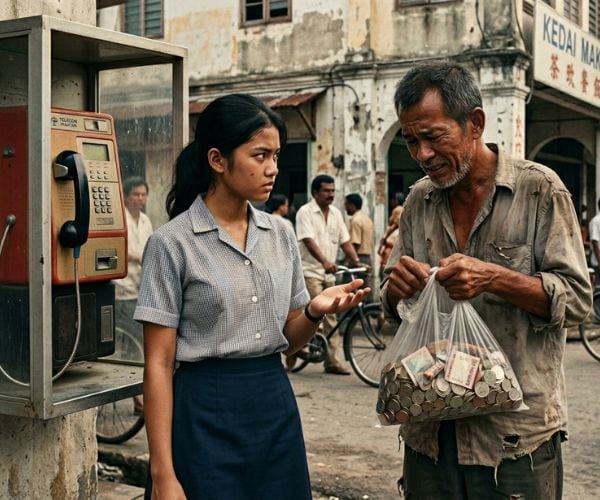
I was standing at a public payphone, waiting my turn. Then, a voice barked from across the road.
The man looked the part. He had weathered clothes and the practiced air of a man defeated by life.
“Hey You! Call this number!” he commanded.
Most people would have felt a twinge of pity. They would see a “beggar” and a “young girl.”
They would expect the girl to gracefully make the call. But I was tired. I had been up since sunrise.
I walked over and looked him in the eye. “Twenty cents,” I said.
“I’m a beggar,” he pleaded. He reached for the script that usually worked.
I didn’t budge. My hard-earned money wasn’t for his convenience.
“The phone doesn’t care,” I told him. “It’s a machine.”
It doesn’t know you’re on the street. It doesn’t care that I just stood for twelve hours to get paid. The phone needs a coin. No money, no call.
No Free Calls
The mask didn’t just slip; it evaporated. The “desperate” man vanished.
He was replaced by a sharp, annoyed businessman.
The older man reached into his pocket. He pulled out a heavy plastic bag stuffed with coins and thick wads of notes.
He had the money He just didn’t want to spend it.
“Today good day,” he shrugged.
“Give me two coins,” I demanded. “One for your call. One for mine.”
He grumbled but paid the “truth tax.” I dropped his coin in and dialed.
“Just say: ‘Pick up. Finished work,'” he yelled.
I told him to be better. I told him to stop scamming poor young workers.
He just laughed.
“Everyone wants to feel nice,” he said.
“They want to feel they helped someone ‘poorer’ than them. Except you. You are the first one I’ve met like this. The rest just have pity. You look at me as an equal human.”
“Yes, we choose differently,” I said.
The Commute
Later, I stood at the dusty bus stop, nursing my sore feet.
Then, a private taxi pulled up.
The “old beggar” climbed in and settled into the backseat. His taxi drove off.
I stood in the exhaust fumes, clutching my bus fare. He was commuting in a luxury I couldn’t afford.
This was my introduction to the human nature of the street. These were the money lessons no school could ever teach.
The Moral
Pity is a blindfold. It makes us feel superior while being scammed. When we look at actions instead of labels, the “victim” often disappears.
Some aren’t asking for help; they are looking for a subsidy from those who have less.
If you use the world’s tools, follow the world’s rules. Especially if you’re taking a private taxi home afterward.


